Hand-drawn Illustration 1

Climb Club began as a weekend meet‑up on local crags and has grown into a creative collective that fuses climbing, film, and collaboration. We believe vertical challenges forge deep bonds and spark uncharted ideas.

Role

Product Designer

Duration

May 2026

Responsibility

UX/UI Deisgn

Type

Hackathon (team of 3) → Solo Revision

Problem

Some feelings have nowhere to go

This is Minji.

Minji is a sophomore studying abroad in the US. Today she found out a girl from her class added everyone on Instagram after their group project.
Everyone except her.

Maybe she just forgot. Maybe she didn't.

It's too tangled to bring up. Too real to just let go.
Not the kind of thing you text someone about, and definitely not the kind of thing you post online.

So it just sits there.

Pain Point

Why existing spaces fall short

01. No safe place to just say it

Too small for therapy,
too personal for social media.

02. Too close to say out loud

Some things are too small to worry your friends
with, or too big to know where to start.

03. Every platform expects something back

Likes, followers, comments, opinions. There's
nowhere to just say something true without it
becoming a thing.

04. Carrying it alone feels heavier

Writing it down helps. But knowing someone else
felt it too. That's what actually makes it lighter.

How might we…

give people a place to say the things that don't fit anywhere else, and let them discover they were never as alone as they thought?

Research

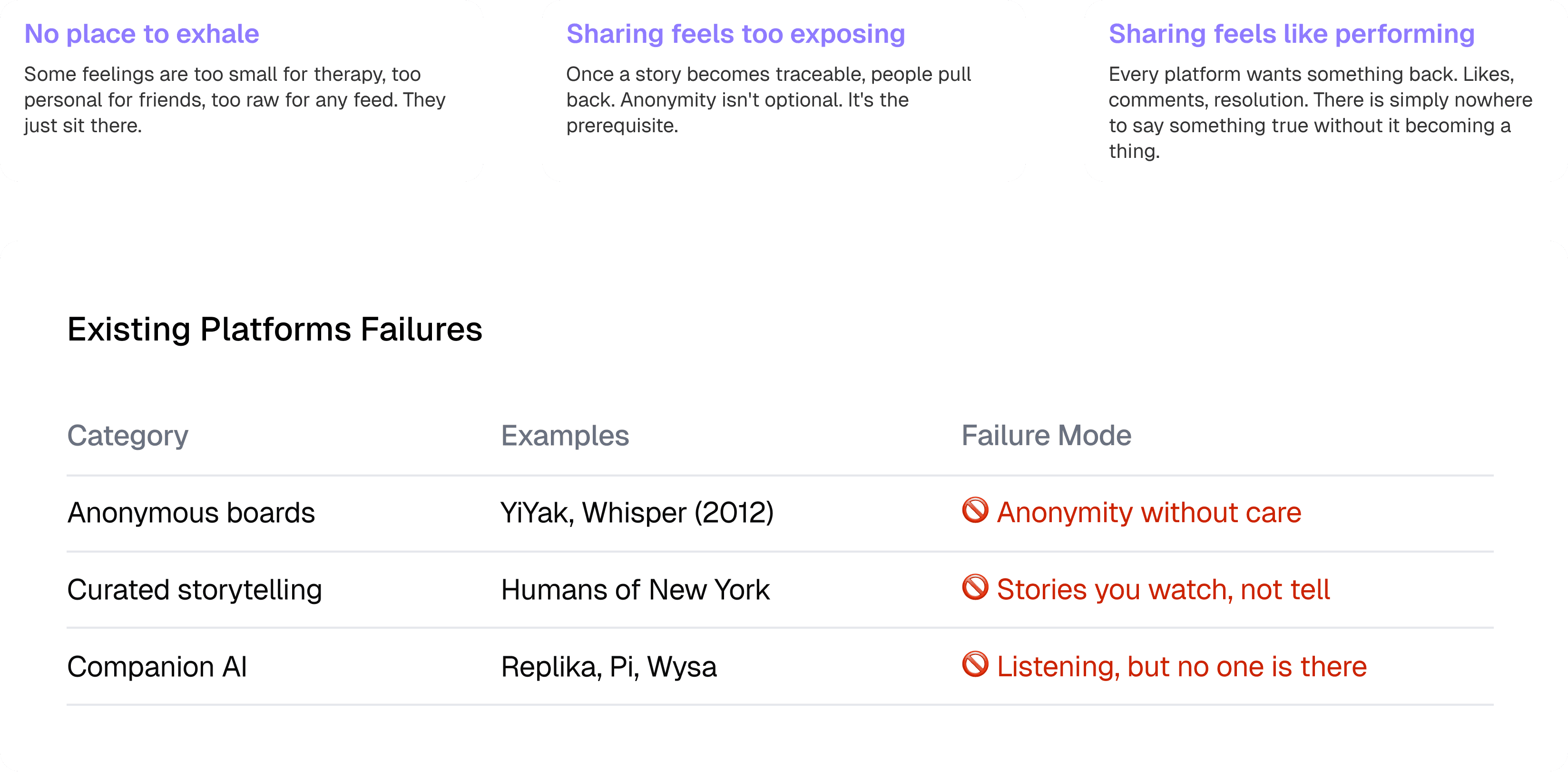
Three Walls That Keep People Quiet

The problem is not that people lack the desire to share. Every existing platform breaks trust at one of three structural points.
Insight

You Don't Need an Audience. You Need an Echo

Every competitor assumes the goal is to be heard by friends, followers, a community, or an AI. That assumption is wrong.

Users carrying these feelings do not need witnesses. They need confirmation that they are not singular in the feeling. That distinction eliminates the need for any audience at all - and points directly to the product's core mechanic.

Ideation

The Smallest Thing That Could Make Someone Feel Less Alone

이거슨 너가 채워봐

01. Solution

Onboarding

Three screens before any feature appears. What Whisper is. How echoes work.
That identity is never shared. Trust is built before the first interaction, not after.

02. Solution

Home & AI response

Four starter prompts - not categories, but permission structures. User taps the closest one to what the user cannot name. The AI responds with acknowledgment only: "You don't have to make sense of it." No advice. The CTA appears after the user shares, never before.

03. Solution

Echo found & echo card

Full-screen: two avatars drawing toward each other. No buttons, no choices. The design is the stillness. Then the card: "A saved voicemail, listened to hundreds of times and still not ready to let go." Different story. Same ache. User saves it.

04. Solution

The whisper map

Emotion planets orbit the avatar center, sized by whisper volume. "Drag to orbit · tap a feeling." Loneliness (142). Warmth (201). Grief (89). Collective scale is legible without surfacing any individual whisper.

05. Solution

Profile: whispers, echoes, and insights

Saved whispers as emotion-colored cards. Saved echoes as a personal archive. An Insights calendar where each whisper day is filled with its emotion color. A Reflect prompt surfaces only when a pattern is real: "You've whispered about loneliness often lately. What would you want someone to know about it?"

01. Solution

Onboarding

Three screens before any feature appears. What Whisper is. How echoes work.
That identity is never shared. Trust is built before the first interaction, not after.

02. Solution

Home & AI response

Four starter prompts - not categories, but permission structures. User taps the closest one to what the user cannot name. The AI responds with acknowledgment only: "You don't have to make sense of it." No advice. The CTA appears after the user shares, never before.

03. Solution

Echo found & echo card

Full-screen: two avatars drawing toward each other. No buttons, no choices. The design is the stillness. Then the card: "A saved voicemail, listened to hundreds of times and still not ready to let go." Different story. Same ache. User saves it.

04. Solution

The whisper map

Emotion planets orbit the avatar center, sized by whisper volume. "Drag to orbit · tap a feeling." Loneliness (142). Warmth (201). Grief (89). Collective scale is legible without surfacing any individual whisper.

05. Solution

Profile: whispers, echoes, and insights

Saved whispers as emotion-colored cards. Saved echoes as a personal archive. An Insights calendar where each whisper day is filled with its emotion color. A Reflect prompt surfaces only when a pattern is real: "You've whispered about loneliness often lately. What would you want someone to know about it?"

Interaction

What the Product Refuses to Do Is the Design

이것도 너가 채워봐 내가 한 것들 내 포폴에서 따왔어 참고해. 내용은 줄게.

Removed -> The echo found screen has no buttons
The interaction design is the absence of interaction - deliberate stillness in a product that otherwise always has a next step.

Constrained -> "See next echo" requires a deliberate tap
A low-prominence text link, not an auto-advancing feed. Prevents compulsion without removing the option.

Removed -> The Insights calendar does not push
Pattern is offered quietly, on the user's terms. The Reflect prompt is a question, not a directive.

Removed -> No social graph anywhere
No follower counts, no comments. The only visible numbers are personal. Nothing to optimize for.

What I Killed, and Why

Three features were removed entirely when walkthroughs revealed they undermined the core principle.

  • Judgmental Color-Coding: Red/yellow/green cues felt like "moderation" to 6 of 9 participants. Shifted users from reflective to defensive mode.

  • Rigid Tone Presets as Default: Locked categories failed edge cases. Replaced with a single swappable slot.

  • Regenerate-Only Rewriting. Lowered perceived authorship in testing. Replaced with "Here's Why" so users rewrite in their own words.

Reflection

What Silence Taught Us About Design

What worked: The echo is the idea. Anonymous boards tried anonymity. Companion AI tried listening. Curated platforms tried storytelling. None tried matching the feeling without connecting the people. That is Whisper's contribution. The conversational home was the right call. Four prompts do more design work than any other element in the product.

What I would do differently: The Explore tap-into-bubble experience is undesigned. What happens when a user taps Loneliness (142)? The tension between discovery and privacy is real and unresolved. Echo matching quality is the make-or-break risk. A mismatched echo breaks the trust the entire product rests on.

01. Solution

Onboarding

Three screens before any feature appears. What Whisper is. How echoes work.
That identity is never shared. Trust is built before the first interaction, not after.

02. Solution

Home & AI response

Four starter prompts - not categories, but permission structures. User taps the closest one to what the user cannot name. The AI responds with acknowledgment only: "You don't have to make sense of it." No advice. The CTA appears after the user shares, never before.

03. Solution

Echo found & echo card

Full-screen: two avatars drawing toward each other. No buttons, no choices. The design is the stillness. Then the card: "A saved voicemail, listened to hundreds of times and still not ready to let go." Different story. Same ache. User saves it.

04. Solution

The whisper map

Emotion planets orbit the avatar center, sized by whisper volume. "Drag to orbit · tap a feeling." Loneliness (142). Warmth (201). Grief (89). Collective scale is legible without surfacing any individual whisper.

05. Solution

Profile: whispers, echoes, and insights

Saved whispers as emotion-colored cards. Saved echoes as a personal archive. An Insights calendar where each whisper day is filled with its emotion color. A Reflect prompt surfaces only when a pattern is real: "You've whispered about loneliness often lately. What would you want someone to know about it?"

Create a free website with Framer, the website builder loved by startups, designers and agencies.